sharing my love of books with you

Author: Cadie (Page 39 of 46)

Stone

Here is a word that I see quite often in British writings, but as an American, I am not familiar with it. I mean, I know what a rock is, but what does a British author mean when he uses the term “stone” for weight. I finally looked it up because I found it in “The Missing Three-Quarter” in The Greatest Adventures of Sherlock Holmes.

Stone – British unit of weight for dry products, generally equivalent to 14 pounds, though it varied from 4-32 pounds for various items over time

Usage: Mr Cyril Overton, sixteen stone of solid bone and muscle, who spanned our doorway with his broad shoulders. (Roughly, about 224 pounds.)

(I believe the sport referenced is soccer, as later in the story “football” is mentioned.)

Distrait

Here is a word that I have always assumed was akin to distraught. I found it again in The Greatest Adventures of Sherlock Holmes in the story of “The Golden Pince-Nez”. I finally looked it up, and though it is similar, it is not quite as dramatic as distraught.

Distrait – distracted or absent-minded

Usage: “Holmes was curiously distrait, and we walked up and down the garden path for some time in silence.”

Palimpsest

Here is a word that I have never heard before. Now that I know what it is, it does not surprise me that Sherlock Holmes was examining one in The Greatest Adventures of Sherlock Holmes before he took the case of “The Golden Piece-Nez”.

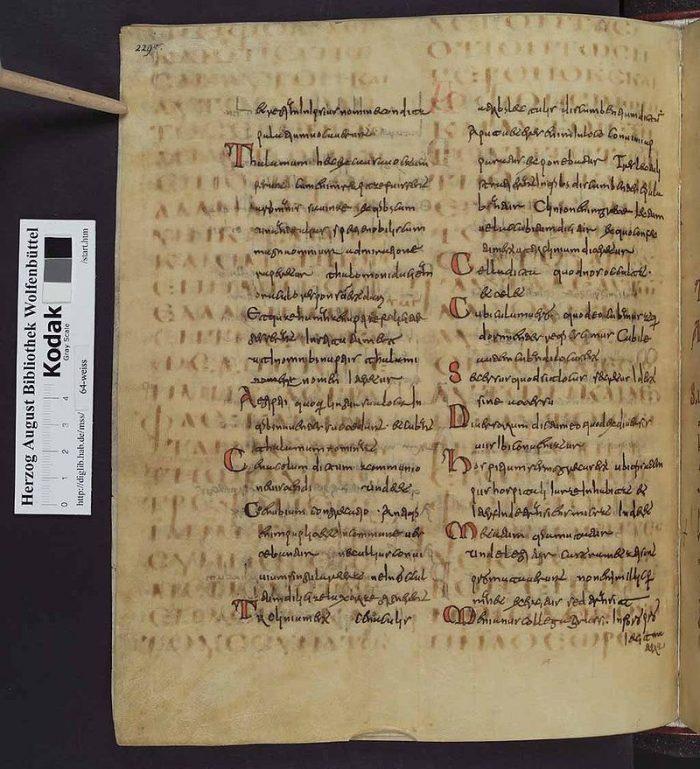
Palimpsest – a manuscript or piece of writing material on which the original writing has been effaced to make room for later writing but of which traces remain

Usage: “He [was] engaged with a powerful lens deciphering the remains of the original inscription upon a palimpsest.”

I am including an image of a palimpsest from Wikipedia. You can clearly see the different texts in this image.

There is no Frigate, by Emily Dickinson

There is no frigate like a book
To take us to lands away,
Nor any coursers like a page
Of prancing poetry.

This traverse may the poorest take
Without oppress of toll;
How frugal is the chariot
That bears a human soul!

(from Selected Poems of Emily Dickinson, printed 2016)

Iconoclast

Here is an interesting word in one of my favorite of The Greatest Adventures of Sherlock Holmes. In “The Six Napoleons”, Holmes utters this word when he is told of three busts of Emperor Napoleon being smashed in the night.

Iconoclast – a person who attacks cherished beliefs or institutions or destroys images such as those used in worship

Usage: “Considering how many hundreds of statues of the great Emperor must exist in London, it is too much to suppose such a coincidence as that a promiscuous iconoclast should chance to begin upon three specimens of the same bust.”

Illimitable

Here is another fun word from The Complete Casebook of Herlock Sholmes. “The Case of the Airman’s Medal” is solved and Sholmes and Jotson are returning to their rooms in Shaker Street. As Sholmes reiterates how he tracked down the missing medal, Jotson cries, “Marvelous!” Sholmes’ reply includes this word.

Illimitable – without limits or an end

Usage: “Not at all!” said Sholmes as we re-entered his room. “To a man of my illimitable deductive powers such work is child’s play!”

Masticate

Here is an interesting word that I found In “The Case of the Airman’s Medal” from The Complete Casebook of Herlock Sholmes. I should have known what it meant by the context, but I was completely puzzled ’til I looked it up.

Masticate – chew (food)

Usage: “You imagine I have bitten off more than I can conveniently masticate.”

An interesting side note: This is the only story listed for 1919 in The Complete Casebook. I wonder if Mr Hamilton took a break from writing about Sholmes just like Sir Arthur Conan Doyle did with Holmes.

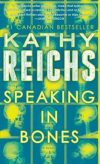
Speaking in Bones, by Kathy Reichs

Speaking in Bones is the latest Kathy Reichs novel that I finished. I have to say, what a plot twist at the end! I definitely did not see that coming!


I think I said this in my last post on Break No Bones, but I thoroughly enjoy Dr Reichs’ style of writing. She adds in knowledge from her own experience as a forensic anthropologist, which enriches the storylines of her novels about Dr Temperance Brennan. Forensics takes time and sometimes multiple people; crime isn’t solved in a day. Reichs acknowledges that in her books.

Another thing that I really like about Dr Kathy Reichs’ style is that it feels so real. You could meet any of the characters walking on the street. She lets the forensics take time, true to life, but the storyline never suffers. If Dr Brennan has to wait through the weekend ’til Monday to speak to someone about the case, then she fills her time digging through receipts for her tax preparer or spending time with her mother.

Something else I really like that I think I mentioned with one of the other books was that I felt like I was investigating along with Dr Brennan. I was able to form my own conclusions by the clues in the book. In this one, I guessed that some of the unidentified remains belonged to a different individual than originally implied, and a few pages later, Dr Brennan decided the same thing. Even though there are plot twists, they are clear, and an astute reader can follow the line of reasoning with the characters to reach the same conclusions.

The first chapter of Speaking in Bones is gripping. I was drawn so quickly into the book that I had to read it really fast to solve the mystery. Dr Brennan is approached by a websleuth who plays a recording of a young and desperate girl. The websleuth, “Lucky”, says she returned to a cold crime scene and found a keychain-sized recording device at the base of a tree. “Lucky” believes the recorded voice belongs to remains in the morgue where Dr Brennan works. Remains that have yet to be identified. Although skeptical, Dr Brennan reexamines the remains and requests the local sheriff aid her in investigating the area where the bones had been found.

As the book progresses, Dr Brennan and the local authorities in several different jurisdictions find more bones that are related to the unidentified remains and the recording. They begin to make headway, the cold case is reopened, and witnesses are approached for more questions. However many of the witnesses seem unwilling to speak to authorities again so many years later. All of the witnesses seem to be connected to a local congregation whose pastor has secrets of his own.

Was the church involved in the disappearance of the girl in the recording? Was there a connection between the recording and the bones? When Dr Brennan goes alone to find the answers to these questions, she places herself in danger. And just when she thinks the danger is ended and the case is solved, she faces an enemy unlike any she has faced before.

Then that ending! I definitely did not see that coming!

Other questions plague Dr Brennan during this investigation, but the most important one is should she marry Detective Andrew Ryan? Why is it so hard to give him an answer? Does she love him? What is she afraid of?

One last word. I really like how the title of the book comes from a compliment paid to Dr Brennan by Detective Slidell (who could be very pompous and annoying). “You know, Doc, when speaking in bones, you’re pretty good.”
 

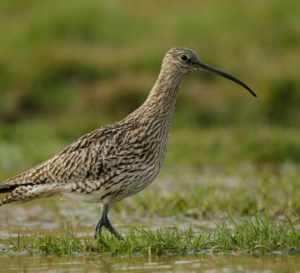
Plover & Curlew

Here is another example of wildlife that Sir Arthur Conan Doyle was most likely very familiar with, but I was not. I decided it would be nice to add pictures of these birds so you can see them too.

European Golden Plover, photo credit eBird.org
Curlew , photo credit Discover Wildlife

These are mentioned in “The Priory School” in The Greatest Adventures of Sherlock Holmes when Holmes is explaining a map of the moor to Watson. “A few moor farmers have small holdings, where they raise sheep and cattle. Except these, the plover and the curlew are the only inhabitants until you come to Chesterfield high road.”

Truculent

Now that I know the definition of this word, it makes sense why Watson would use it to describe himself and Holmes in “Charles Augustus Milverton” in The Greatest Adventures of Sherlock Holmes.

Truculent – aggressively self-assertive; scathingly harsh; feeling or displaying ferocity

Usage: “With our black silk face-coverings, which turned us into two of the most truculent figures in London, we stole up to the silent, gloomy house.”

“Charles Augustus Milverton” is another Holmes tale that offers such an interesting plot twist that even Sherlock Holmes didn’t foresee it.

« Older posts Newer posts »