sharing my love of books with you

Category: Bookish Thoughts (Page 19 of 43)

Thank You to my Aunt!

I have been meaning to write this thank you post for my Aunt, a librarian, who rescued these old books to give to me. I love having old books on my shelf. It’s nice to think about the people who loved them before me. How many hands have held the covers and turned the pages? What is written in the flyleaf? Did I say I love old books?
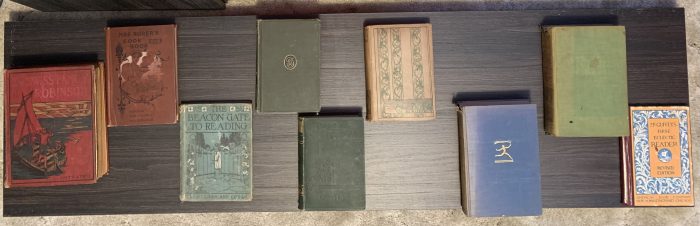
Titles in Order: Swiss Family Robinson, Mrs. Rorer’s Cook Book, The Beacon Gate to Reading, Life on the Mississippi, Rose in Bloom, Jane Eyre, Les Miserables, The Standard Book of British and American Verse, McGuffey’s First Eclectic Reader, revised edition

Swiss Family Robinson, by Robert Louis Stevenson, copyright 1882, and illustrated. This copy has some pages falling out. It is yellowed and worn. There is a name on the first page and the date 4/19/09. When I read this copy, I plan to read it very carefully.

Mrs. Rorer’s Cook Book, by Mrs S. T. Rorer, copyright 1886. This “Manual of Home Economics” is in remarkable shape for its age. There is a lovely picture of Mrs. Rorer with a tissue sheet between the picture and the title page. There is a handwritten recipe for fudge dated December 1907 and a Lemon Pie recipe from 1901.

The Beacon Gate to Reading, by M.E. Sullivan and Philena Morris Cox, copyright 1926. The name of this flyleaf is Mrs Knuss (I think). This is a little primer that was used by young children to learn to read. There are even colored pictures and practice pages. A few of the practice pages have been practiced on.

Life on the Mississippi, by Mark Twain, copyright 1917. There is an illustration across from the title page. I believe the book is part seven of a set called The Complete Works of Mark Twain. There is a roman numeral VII on the spine, as well as an engraving of the profile of Mark Twain.

Rose in Bloom, by Louisa M. Alcott, copyright 1904. Like Mrs. Rorer’s cookbook, there is a picture with a tissue cover next to the title page. This volume also has illustrations. I haven’t read much of Louisa May Alcott, so I look forward to reading this book. Although, it is titled “A Sequel to Eight Cousins“, so I may need to read that first.

Jane Eyre, by Charlotte Bronte. There is no copyright date on this book, but the inscription on the flyleaf says “From Grandma, Christmas 1897”. This copy of Jane Eyre has lovely detailing on the cove of green vines; you can see them in the picture.

Les Miserables, by Victor Hugo. There is no copyright date. This volume is in exceptional condition; there is just a little tear on the spine. This is my third copy of Les Miserables which I intend to read again soon so I can share it with you. It is one of my favorite stories.

The Standard Book of British and American Verse, selected by Nella Braddy, copyright 1932. One of the special things I noticed about this book was the list of authors. The list includes the authors’ names and birth to death years. When this volume was published, poets like William Butler Yeats, Robert Frost, and Rudyard Kipling were still alive. The note on the flyleaf says, “A gift to one who is so versatile, from one who loves to see people like that.” I’m looking forward to reading the poems in this volume.

McGuffey’s First Eclectic Reader, revised edition, copyright 1920. This is in the best condition of these books. The binding is till tight and the pages clean. I may even be able to use it with my own children one day. McGuffey has a great reputation for teaching children to read.

There is no such thing as too many books. Thank you, Aunt, for giving these to me!

The Lake of Innisfree, by William Butler Yeats

I will arise and go now, and go to Innisfree,
And a small cabin build there, of clay and wattles made;
Nine bean rows will I have there, a hive for the honey bee,
And live alone in the bee-loud glade.

And I shall have some peace there, for peace comes dropping slow,
Dropping from the veils of the morning to where the cricket sings;
There midnight's all a glimmer, and noon a purple glow,
And evening full of the linnets wings.

I will arise and go now, for always night and day
I hear lake water lapping with low sounds by the shore;
While I stand on the roadway, or on the pavements gray,
I hear it in the deep heart's core.

("The Lake of Innisfree", by William Butler Yeats, printed in Poems of the Irish People, 2016)

I think Mr Yeats and I have similar dreams for finding peace. He dreams in this poem of a cabin by the lake where he can have a garden and bee hive. It is a place where he can listen to the waves and watch the sunrise and sunset. It is a place he doesn’t have yet, because he stands on the roads and pavements yearning for it. I feel the same way when I drive to work every day. I want a place where I can watch the sun rise and keep a nice garden and have great, tall trees, but I don’t have that peaceful place yet.

The Famine Year, by Lady Wilde

Weary men, what reap ye? - Golden corn for the stranger.
What sow ye?- Human corses that wait for the avenger.
Fainting forms, hunger-stricken, what see ye in the offing?- 
Stately ships to bear our food away, amid the stranger's scoffing.
There's a proud array of soldiers - what do they round your door?
They guard our master's granaries from the thin hands of the poor.
Pale mothers, wherefore weeping? Would to God that we were dead - 
Our children swoon before us, and we cannot give them bread.

Little children, tears are strange upon your infant faces,
God meant you but to smile within your mother's soft embraces.
Oh, we know not what is smiling, and we know not what is dying;
But we're hungry, very hungry, and we cannot stop our crying.
And some of us grow old and white - we know not what it means;
But, as they lie beside us we tremble in our dreams.
There's a gaunt crowd on the highway - are you come to pray to man,
With hollow eyes that cannot weep, and for words your faces wan?

No; the blood is dead within our veins - we care not now for life; 
Let us die hid in the ditches, far from children and from wife!
We cannot stay and listen to their raving famished cries - 
Bread! Bread! Bread! and none to still their agonies.
We left our infants playing with their dead mother's hand: 
We left our maidens maddened by the fever's scorching brand:
Better, maiden, thou wert strangled in thy own dark-twisted tresses - 
Better, infant, thou wert smothered in thy mother's first caresses.

We are fainting in our misery, but God will hear our groan;
Yet, if fellowmen desert us, will He hearken from His throne?
Accursed are we in our own land, yet toil we still and toil; 
But the stranger reaps our harvest - the alien owns our soil.
O Christ! how have we sinned, that on our native plains
We perish homeless, naked, starved, with branded brow like Cain's?
Dying, dying wearily, with a torture sure and slow - 
Dying as a dog would die, by the wayside as we go.

One by one they're falling round us, their pale faces to the sky; 
We've no strength left to dig them graves - there let them lie.
The wild bird, if he's stricken, is mourned by the others,
But we - we die in Christian land, - we die amid our brothers,
In a land which God has given us, like a wild beast in his cave,
Without a tear, a prayer, a shroud, a coffin, or a grave.
Ha! but think ye the contortions on each livid face ye see,
Will not be read on Judgement-day by eyes of Deity?

We are wretches, famished, scorned, human tools to build your pride,
But God will yet take vengeance for the souls for whom Christ died.
Now in your hour of pleasure - bask ye in the world's caress; 
But our whitening bones against ye will rise as witnesses,
From the cabins and the ditches in their charred, uncoffined masses,
For the Angel of the Trumpet will know them as he passes.
A ghastly special army, before the great God we'll stand
And arraign ye as our murderers, the spoilers of our land!

("The Famine Year" by Lady Wilde, printed in Poems of the Irish People, 2016)

This poem reminds me of one of my favorite books, Nory Ryan’s Song, by Patricia Reilly Giff. Though it is a children’s book, it tells the story of the Irish Potato Famine and the sorrows felt by the Irish during that time. I will re-read it and share it with you soon. I hope you liked this poem. It is sad, but I feel like it has a triumphant and hopeful ending.

Terrapin

Terrapin – any of several species of North American fresh-water or tidewater turtles characterized by a horny beak, a shield covered with epidermic plates, and partly webbed feet

“[Roosevelt] weighed eight and a half pounds and began life as a hearty baby, bright and hyperactive. His mother remarked that he looked like a terrapin, but he was soon declared a beautiful child, blond and blue-eyed.”

Lion in the White House, Aida D. Donald

Ameliorate

Ameliorate – to grow better or less severe

“That private charity could only ameliorate conditions would be revealed to [Theodore Roosevelt Sr’s] son a generation later.”

Lion in the White House, Aida D. Donald

New Book: Poems of the Irish People

I am home sick today, so I decided to grab this small book off my shelf. Poems of the Irish People is a pocket-sized compilation of Irish poetry printed by Fall River Press. I chose this for today as a break from my current, more intense readings. (Hey, I’m sick, so I really don’t feel like reading biography today.) I already finished part one, poems about The Land. Some of the poems hail the beauties of Ireland; others mourn the fact that the author may never see their fair land again. I’m about to start part two, The Lore. I’m looking forward to the poems of leprechauns and Fair Folk. The third part is The People. I’m not sure what poems await – possibly a few ballads about lost loves. I’ll let you know what I think when I’ve finished, and I’ll try to share a few poems with you later. Now, back to Ireland.

Ebullient

Ebullient – overflowing with enthusiasm, high spirits, etc; showing much exuberance or exhilaration

“[Roosevelt’s] ebullient and joyful persona entranced voters.”

from the introduction to Lion in the White House, Aida D. Donald

“The colonel [Roosevelt] was probably the best-known politician in the country, having been a military hero and in public life since the age of twenty-three. His ebullient personality, varied talents, war record, and reputation as a reformer – although a not wholly successful one – in an age of acute conservatism made him a popular figure.”

Lion in the White House, Aida D. Donald

Remembered Music, by Rumi

'Tis said the pipe and lute that charm our ears
Derive their melody from rolling spheres;
But Faith, overpassing speculations bound
Can see what sweetens every jangled sound.

We, who are parts of Adam, heard with him
The song of angels and of seraphim.
Our memory, though dull and sad, retains
Some echo still of those unearthly strains.

Oh, music is the meat of all who love,
Music uplifts the soul to realms above.
The ashes glow, the latent fires increase;
We listen and are fed with joy and peace.

("Remembered Music" translated by R.A. Nicholson, Rumi, printed 2006)

A Quatrain by Rumi

Today, like every other day, we wake up empty and frightened. Don’t open the door to the study and begin reading. Take down a musical instrument.

Let the beauty we love be what we do. There are hundreds of ways to kneel and kiss the ground.

A Quatrain by Rumi, Rumi, translated by Coleman Barks

Theodore Roosevelt as a Child

“He often put frogs under his hat, letting them leap out as he saluted friends on the street, dropped snakes in water glasses at the dinner table, and hid odd creatures in the icebox.”

Lion in the White House, Aida D. Donald
« Older posts Newer posts »