A COLLECTION OF BOOKISH THOUGHTS

sharing my love of books with you

Page 33 of 46

Pawky

Here is an interesting word that Sherlock Holmes used to describe Dr Watson in The Valley of Fear, one of the The Greatest Adventures of Sherlock Holmes. I wasn’t fully able to grasp the meaning of the word by the context, so I had to look it up. Now I find the context that much more enlightening and certainly more humorous.

Pawky – having a mocking or cynical sense of humor

Usage: Holmes says to Watson, “You are developing a certain unexpected vein of pawky humor, Watson, against which I must learn to guard myself.”


Miasmatic

Here is a word that sounds as gross as its definition. It is one of the words Sir Arthur Conan Doyle used to describe the Grimpen Mire in The Hound of the Baskervilles, one of The Greatest Adventures of Sherlock Holmes. Watson and Holmes chase the villain into the mire on a dark and foggy night. It was very dangerous for them all.

Miasmatic – a vapor from decaying organic matter

Usage: “Rank weeds and lush, slimy water-plants sent an odor of decay and a heavy miasmatic vapor onto our faces, while a false step plunged us more than once thigh-deep into the dark, quivering mire, which shook for yards in soft undulations around our feet.”

Sherlock Holmes’s Defect

“One of Sherlock Holmes’s defects – if, indeed, one may call it a defect – was that he was exceedingly loth to communicate his full plans to any other person until the instant of their fulfillment. Partly it came no doubt from his own masterful nature, which loved to dominate and surprise those who were around him. Partly also from his professional caution, which urged him never to take any chances. The result, however, was very trying for those who were acting as his agents and assistants.”

Dr Watson, The Hound of the Baskervilles, Sir Arthur Conan Doyle, circa 1902

Elucidate

Here is a word that Charles Hamilton uses frequently in The Complete Casebook of Herlock Sholmes. The definition makes it clear why. The exploits of Herlock Sholmes always require an explanation.

Elucidate – to make clear by explaining

Usage:

“I gazed silently at Herlock Sholmes. Well, as I knew his extraordinary powers, it appeared to me that this problem was beyond elucidation.” (“The Case of the Musician”)

“The sudden and startling death of Mr Swizzle caused a considerable sensation, and I was not surprised when my amazing friend Mr Herlock Sholmes was called in to aid in elucidating the mystery.” (“The Mystery of the Taxi-Cab”)

“A few questions to Mr Voxbuster elucidated the whole mystery.” (“The Mystery of the Garden Suburb”)

Circumlocution in Holmes

Here is a funny word that I learned while reading The Complete Casebook of Herlock Sholmes. Usually the context is satire against government. So imagine my surprise when I found this word in The Valley of Fear, one of The Greatest Adventures of Sherlock Holmes. There is no satire in this context, just the plain meaning of the word.

“It may have been that his attentions to Ettie had been more evident than before, or that they had gradually obtruded themselves into the slow mind of his good German host; but, whatever the cause, the boarding-house keeper beckoned the young man into his private room and started on the subject without any circumlocution.”

Sholmes Before a Case

“”Pass me the looking-glass.”

“What are you going to do with the looking-glass, Sholmes?” I asked, in surprise.

“Reflection is necessary before we act in this case, Jotson.”

Herlock Sholmes and Dr Jotson, “The Mysterious Bottle”, The Complete Casebook of Herlock Sholmes, Charles Hamilton, circa 1920

Remember Venerable?

Do you remember that I posted the definition of Venerable not long ago? I came across the word again in The Valley of Fear, one of The Greatest Adventures of Sherlock Holmes. It was neat that, having previously looked the word up, I knew exactly what Dr Watson meant when he said this.

“Three centuries had flowed past the old Manor House, centuries of births and homecomings, of country dances and of the meetings of fox-hunters. Strange that now in its old age this dark business should have cast its shadow upon the venerable walls!”

Dr Watson, The Valley of Fear, Sir Arthur Conan Doyle, circa 1914

Pollarded Elms

We walked down the quaint village street with a row of pollarded elms on each side of it.

Dr Watson, The Valley of Fear, Sir Arthur Conan Doyle, circa 1914

I came across this quote in The Valley of Fear, one of The Greatest Adventures of Sherlock Holmes. As an amateur gardener, I wondered if “pollarded” might mean how the elms were pruned or cut back. That was exactly what I found. Here is a great article about Pollarding from The Daily Garden.

According to the article, pollarding is a type of pruning where all new growth is cut back, leaving the trees with a short, post-like trunk with many smaller branches that grow upwards. Some of the benefits of pollarding are short trees that won’t blow over in wind storms and less large limbs that may fall on power lines and roofs.

Here are some pictures from The Daily Garden:

Shortly after pollarding…
… and two years later.

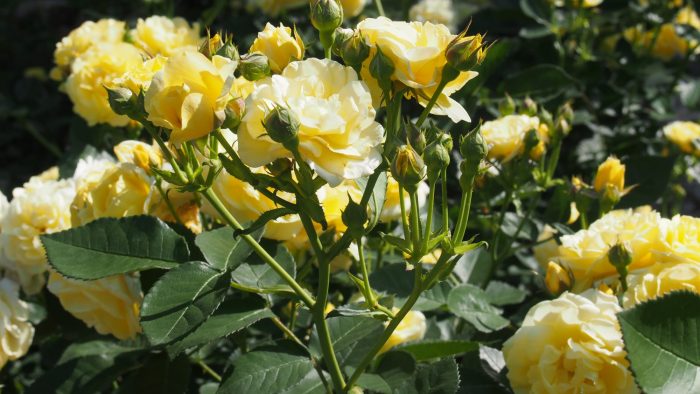
Sulphur Rose

Here is a flower that Dr Watson alludes to when he is describing the beauty of a woman he meets in The Hound of the Baskervilles, one of The Greatest Adventures of Sherlock Holmes. I looked it up to find a picture, and it really is a pretty flower.

photo credit Southern Living

Usage: “Her eyes and hair were of the same rich hazel color, and her cheeks, though considerably freckled, were flushed with the exquisite bloom of the brunette, the dainty pink which lurks at the heart of the sulphur rose.”

« Older posts Newer posts »