A COLLECTION OF BOOKISH THOUGHTS

sharing my love of books with you

Page 40 of 46

A Tribute to the Thesaurus

Have you ever thought what a wonderful thing a thesaurus is? It’s not quite a dictionary; those give you the definition of words and sometimes examples of how to use words in a sentence. A thesaurus doesn’t do that. It doesn’t impose upon your thoughts; it strives to broaden them. Do you think you know what that word means? Well then, here are ten or twenty more words that are similar. Do you want to sound more learned? More vulgar? Are you trying to be proper or unpolished? (I used the thesaurus to find that one.)

In this age of the internet, I suppose the thesaurus seems outdated, like a card catalog. Do you need to know a definition? Google, what does this word mean? Want a few variations? Thesaurus.com, give me synonyms for this word. In fact, it’s been a long time since I opened my own thesaurus. But when I did, just a few moments ago, it was like a time machine taking me back to memories of younger days. I believe it is good for the soul to look up words in a physical thesaurus every now and again. And for those who don’t know, a thesaurus is used to find either synonyms or antonyms of words and phrases.

My mother introduced me to Roget’s Thesaurus many years ago. She had a huge paperback copy whose spine I creased in several places over the years.

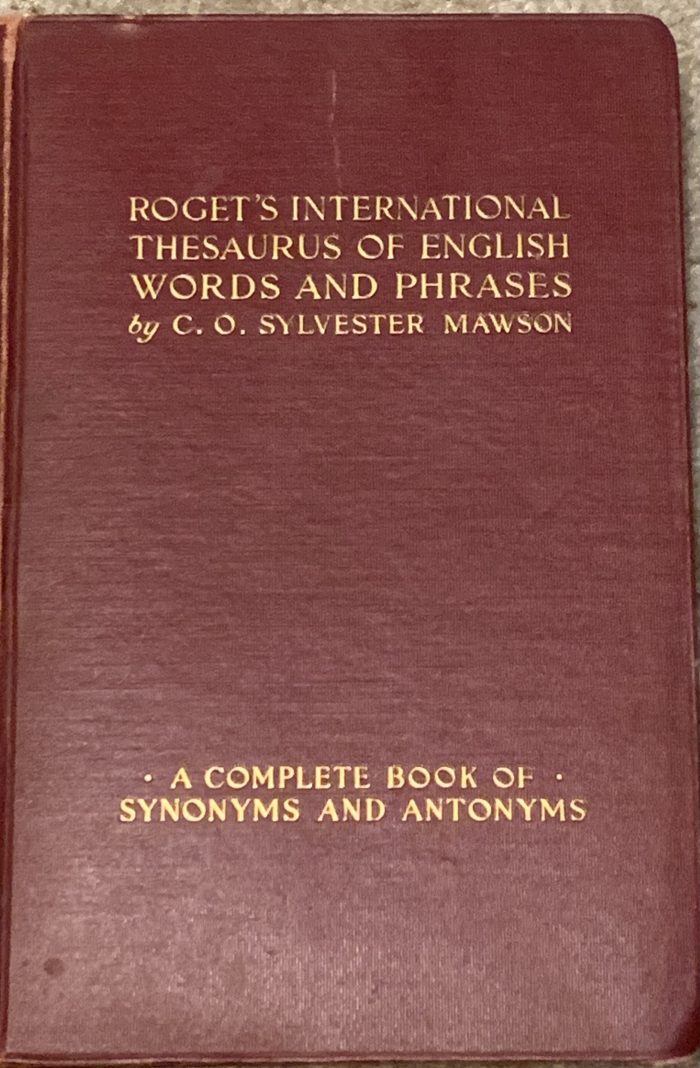
Now, I own my own copy of Roget’s Thesaurus, pictured above. It is a hardback, printed in 1923. It smells kind of musty, but it is my own. I pulled it off my shelf to help me write a poem about the summer heat. There are so many words to describe heat: summer, tropical, blaze, swelter, singe, burn, fiery. The entry takes almost a whole page. Then it continues to calefaction, which is the state of being warmed. Furnace is next, then thermometer. I can use so many of the words listed in my poem. Or, I could look back in the index to find other uses for heat, like the heat of passion if I that is what I wanted to write about.

I suppose my copy of Roget’s Thesaurus is a bit out of date. In the last hundred years, I’m sure at least a hundred words were added to it, and another hundred were removed for the mere crime of being outdated, archaic, ancient, or antique (thesaurus again). But I don’t mind. I still think a thesaurus – no matter how old – is a wonderful, astonishing, marvelous thing!

Dolorously

This descriptive word was found in the first paragraph of “The Priory School” in The Greatest Adventures of Sherlock Holmes. The definition surprised me a little, but it makes sense now that I have read the story.

Dolorous – causing, marked by, or expressing misery or grief

Usage: “The heavy, white face was seamed with lines of trouble, the hanging pouches under the closed eyes were leaden in color, the loose mouth drooped dolorously at the corners, the rolling chins were unshaven.”

Dr Watson is describing a man who staggered up the steps at their Baker Street rooms and collapsed at the door in anguish. Why? You’re going to have to read “The Priory School”.

Ostler

Here, I think, is an old word that we don’t use much anymore. I wasn’t very sure what it meant exactly when I read it in “The Solitary Cyclist” in The Greatest Adventures of Sherlock Holmes, so I had to look it up. However, I am not regularly around stables or people who deal directly with horses, so this word may still be used regularly in some circles.

Ostler – one who takes care of horses and mules (according to Merriam-Webster, it is “less common variant of hostler”)

Usage: Holmes sent the ostler to fetch the constables, glad he had not suffered ill-effects from an earlier club to the head.

Greensward

I found this word in “The Solitary Cyclist” in The Greatest Adventures of Sherlock Holmes. I should have guessed the meaning by the context, but its so simple, and I had no clue.

Greensward – grass-covered ground (see? simple)

Usage: “We had broken suddenly into a lovely glade of greensward surrounded by ancient trees.”

(You will have to read “The Solitary Cyclist” to find out why Holmes and Watson were breaking so suddenly into a grassy area. It’s part of the plot twist of the story.)

Flowering Gorse

As I was reading “The Solitary Cyclist” in The Greatest Adventures of Sherlock Holmes, I realized it would be nice sometimes to include pictures of the flowers or birds that Watson describes. As an American, I don’t usually get to see the same kind of wildlife that Sir Arthur Conan Doyle saw everyday. Pictured below is the Common Gorse, or as Watson called it, the Flowering Gorse. Picture credit goes to The Wildlife Trusts.

Gorse (Ulex europaeus) growing alongside country lane, Shropshire, UK

Usage: “A rainy night had been followed by a glorious morning, and the heath-covered countryside, with the flowering gorse, seemed all the more beautiful to the eyes which were weary of the duns and drabs and slate grays of London.”

Dr Jotson on Surgery

“I was busy that afternoon, having several operations to perform, and the subsequent death-certificates to sign.”

“A Murder Mystery”, The Complete Casebook of Herlock Sholmes, Charles Hamilton, circa 1918

Inspector Pinkeye on the Case

“An extraordinary case, Mr Sholmes,” said the inspector. “Mr Skinnem, the managing director of Messrs. Skull & Krossbones, the shipowners, was found dead in his private office. There was no sign of violence about the body, and death had apparently been instantaneous. The medical evidence is the Mr Skinnem had been the victim of a sudden shock – how administered, it is for the police to discover.”

“A Murder Mystery”, The complete Casebook of Herlock SHolmes, Charles Hamilton, circa 1918

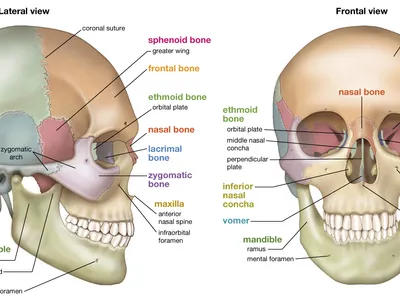
Zygoma

Here is an anatomical word from Speaking in Bones. Since I wasn’t sure exactly what this was, I looked it up and decided to share.

Zygoma – the bony arch of the cheek formed by connection of the zygomatic and temporal bones

Usage: “I suffered a concussion and a hairline fracture of my right zygoma.”

I’m including a diagram to help with placement. I hope you don’t think it’s too gross. Photo credit Britannica.com.

Untoward

The curious case of “The Solitary Cyclist” developed into an actual tale of crime and had a twist that I didn’t see coming. This is one of The Greatest Adventures of Sherlock Holmes. I didn’t foresee the ending, but Holmes did, and used this word to describe what he was anticipating.

Untoward – unexpected and inappropriate or inconvenient

Usage: “I think, Watson, that we must spare time to run down together on Saturday morning and make sure that this curious and inclusive investigation has no untoward ending.”

Odious

Here is a word that Dr Watson uses regularly to describe the villains in The Greatest Adventures of Sherlock Holmes. In particular, this is how he described Mr Woodley, the abductor, in “The Solitary Cyclist” and Mr Milverton, the blackmailer, in “Charles Augustus Milverton”.

Odious – extremely unpleasant and revulsive

Usage: “That odious man, Mr Woodley.”

« Older posts Newer posts »