sharing my love of books with you

Tag: New Words (Page 16 of 20)

Venerable

I found this word in the case of “The Missing Three-Quarter” in The Greatest Adventures of Sherlock Holmes. It is another word that I have skimmed over in the past, so I thought I would look it up this time to be sure it meant what I thought it did. I was wrong. I thought it would mean friendly, but it does not.

Venerable – accorded a great deal of respect, especially because of age, wisdom, or character

Usage: “No doubt you will find some sights to amuse you in this venerable city.”

I suppose Cambridge can definitely be called old and respectable.

Sardonic

Here is a word that I have read over many times before because I can guess the meaning by the context. But when I came across it in “The Missing Three-Quarter” in The Greatest Adventures of Sherlock Holmes, I decided to look it up instead of just skimming by.

Sardonic – grimly mocking or cynical

Usage: Holmes is telling Watson how he was following a suspect. He was on a bicycle, and the suspect was in a carriage. “The carriage stopped, the doctor alighted, walked swiftly back to where I had also halted, and told me in an excellent sardonic fashion that he feared the road was narrow, and that he hoped his carriage did not impede the passage of my bicycle.”

Chubbs Key

I came across this term when I was reading “The Golden Pince-Nez” in The Greatest Adventures of Sherlock Holmes. It has led me to a bit of a history lesson. Sir Arthur Conan Doyle uses it in such a simple way, as though all of his readers are familiar with Chubbs Keys and Chubbs Locks. I suppose there was a time when at least all of England knew about Chubbs.

In this story, Holmes is trying to figure out who murdered Mr Willoughby Smith, secretary to Professor Coram and why Mr Smith would have a gold pince-nez clutched in his hand when he died. During his initial inquiries, Holmes mentions a scratch on a locked bureau that could not have been present the day before. Asking about the key, he is told by the housekeeper, “The Professor keeps it on his watch-chain.”

“Is it a simple key?”

“No, sir, it is a Chubb’s key.”

“Very good.”

You can see why my curiosity would be peaked. Though I didn’t know what a Chubbs key was, Holmes knew, and it made sense to him. Further, in his mind, it also explained the scratch.

In 1818, locksmith Jeremiah Chubbs patented a “detector lock” that was designed to keep any but the right key out. If someone tried to pick the lock, the detector mechanism would fall into place, keeping the imposter out and warning the owner that the lock had been tampered with. The original patent was for a lock with two keys, one to open it regularly and one to open the detector mechanism. In 1824, Jeremiah’s brother, Charles Chubb, patented a detector lock with only one key. The brothers would go on to become well known in the world of locksmiths and security. Their company would change names as fathers died and sons took over, and again as they bought out other locksmith companies. When Doyle wrote “The Golden Pince-Nez”, circa 1904, there were two Chubbs factories, one in London and the other in Wolverhampton.

If you would like to learn more about Chubbs locks, I am including a link to an article that I found helpful in my little bit of research for this post. I am sure a Google search would turn up more results for you if you wanted to look further. And as always, I also think you should read “The Golden Pince-Nez” at least once through so you can see how Holmes solves the case.

A Gazetteer of Lock and Key Makers by Jim Evans copyright 2002

(I have no affiliation with this website; I just found the article and pictures helpful for my own understanding.)
Farcical

I came across this fun word in “The Second Stain”, one of The Greatest Adventures of Sherlock Holmes. I call it a fun word not only because of its meaning, but also because it just sounded neat in my head when I read it.

Farcical – of, relating to, or resembling farce; ludicrous; laughably inept

Usage: “This is a farcical waste of time, but still, if nothing else will satisfy you, it shall be done.”

Drugget

Here is a word from one of The Greatest Adventures of Sherlock Holmes called “The Second Stain”. It must mean carpet based on the context in which it is used, but I still looked it up just to be sure.

Drugget – a course, durable cloth used chiefly as a floor covering

Usage: “The carpet was a small, square drugget in the center of the room.”

Beeswing

This is a word I had never heard before I read it in “The Abbey Grange” in The Greatest Adventures of Sherlock Holmes. It was very important to me to understand what it meant because it was vital to the solving of this baffling case.

Beeswing – a film of shining scales of tartar formed in port and some other wines after long keeping

Usage: “The three glasses were grouped together, all of them tinged with wine, and one of them containing some dregs of beeswing.

Assiduously

This is a word that I have not come across often, so I had to look it up to make sure I understood its full meaning. I found it this time in “The Abbey Grange” in The Greatest Adventures of Sherlock Holmes.

Assiduously – with great care and perserverance

Usage: The lady had a large, plum colored swelling over one eye “which her maid, a tall, austere woman, was bathing assiduously with vinegar and water.”

Stone

Here is a word that I see quite often in British writings, but as an American, I am not familiar with it. I mean, I know what a rock is, but what does a British author mean when he uses the term “stone” for weight. I finally looked it up because I found it in “The Missing Three-Quarter” in The Greatest Adventures of Sherlock Holmes.

Stone – British unit of weight for dry products, generally equivalent to 14 pounds, though it varied from 4-32 pounds for various items over time

Usage: Mr Cyril Overton, sixteen stone of solid bone and muscle, who spanned our doorway with his broad shoulders. (Roughly, about 224 pounds.)

(I believe the sport referenced is soccer, as later in the story “football” is mentioned.)

Distrait

Here is a word that I have always assumed was akin to distraught. I found it again in The Greatest Adventures of Sherlock Holmes in the story of “The Golden Pince-Nez”. I finally looked it up, and though it is similar, it is not quite as dramatic as distraught.

Distrait – distracted or absent-minded

Usage: “Holmes was curiously distrait, and we walked up and down the garden path for some time in silence.”

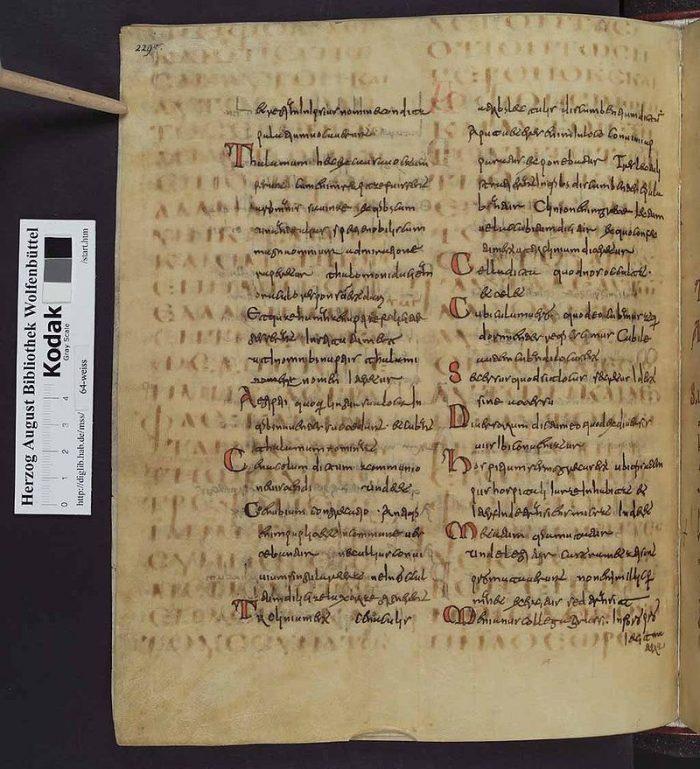
Palimpsest

Here is a word that I have never heard before. Now that I know what it is, it does not surprise me that Sherlock Holmes was examining one in The Greatest Adventures of Sherlock Holmes before he took the case of “The Golden Piece-Nez”.

Palimpsest – a manuscript or piece of writing material on which the original writing has been effaced to make room for later writing but of which traces remain

Usage: “He [was] engaged with a powerful lens deciphering the remains of the original inscription upon a palimpsest.”

I am including an image of a palimpsest from Wikipedia. You can clearly see the different texts in this image.

« Older posts Newer posts »