sharing my love of books with you

Tag: New Words (Page 15 of 20)

Hart’s Tongue Fern

Here is another example of moorland foliage that Sir Arthur Conan Doyle would have been familiar with, but that I have never seen here in America. The Hart’s-Tongue Fern is mentioned several times in The Hound of the Baskervilles, one of The Greatest Adventures of Sherlock Holmes. I found this really neat website, Woodland Trust, with pictures of the fern as well as some interesting background on the fern.


Photo Credit Woodland Trust

According to Woodland Trust, the Hart’s-Tongue Fern is a sign of ancient woodland and may indicate that its habitat is unique. Some of the United Kingdom’s ancient woodlands date back to the 1600s. Woodland Trust has another full article about what ancient woodlands are and how to spot them.

Dr Watson mentions in The Hound of the Baskervilles that there are old stone huts on the moor, indicating a thriving, ancient civilization that lived there once. One of the characters, Dr Mortimer, studies those ancient people by excavating near the ruins and recovering skeletons and other artifacts. Holmes himself makes use of the ruins when he needs a place to hide and watch the villain. It is safe to say, then, that the moor, as Dr Watson described it, is ancient.
Wagonette and Cobs

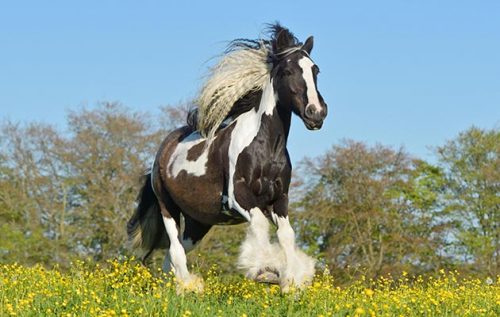
I found these two words in “The Hound of the Baskervilles” in The Greatest Adventures of Sherlock Holmes. To find the meaning of the words this time, I turned to a Sherlock Holmes website. From the context, I could guess that wagonette was some kind of horse drawn wagon and cobs were the horses. And that is exactly what it meant.

Wagonette and Cobs – A wagonette, as its name implies, was an open wagon with side benches, rather more rustic than any conveyance Watson would have been used to in London. Cobs are sturdy draft horses, used for farm work. (definition found on Discovering Sir Arthur Conan Doyle from Stanford University)

Usage: “The train pulled up at a small wayside station and we all descended. Outside, beyond the low, white fence, a wagonette with a pair of cobs was waiting.”

photo credit Horse & Hound

Gainsaid

Here is an odd word that I have read over before, but never tried to find out the true meaning. I found it this time in “The Hound of the Baskervilles” in The Greatest Adventures of Sherlock Holmes.

Gainsaid – past tense of gainsay – to deny; dispute; contradict

Usage: “This Manor of Baskerville was held by Hugo of that name, nor can it be gainsaid that he was a most wild, profane, and godless man.”

Draghound

Here is an interesting word that I found in “The Missing Three-Quarter” in The Greatest Adventures of Sherlock Holmes. I could tell the meaning just by the context, but wanted to share it with you too.

Draghound – a hound trained to follow a scent made with a drag

Usage: “Let me introduce you to Pompey,” said he. “Pompey is the pride of the local draghounds – no great flier, as his build will show, but a staunch hound on the scent.”

(Another book that mentions this method of training hounds is Where the Red Fern Grows. I will write that about another day.)

Fulsome

Here is another word from Dr Mortimer in “The Hound of the Baskervilles” in The Greatest Adventures of Sherlock Holmes. After admiring Holmes’ dolichocephalic skull, Dr Mortimer utters this word.

Fulsome – complimentary or flattering to an excessive degree

Usage: “It is not my intention to be fulsome, but I confess that I covet your skull.”

Dolichocephalic

“The Hound of the Baskervilles” in The Greatest Adventures of Sherlock Holmes has proved to have several very interesting words that I have not read before, or at least that I have not heard often. One of the main characters, Dr Mortimer, mentions this word when he first meets Sherlock Holmes.

Dolichocephalic – having a relatively long head with cephalic index of less than 75

(cephalic index – according to Merriam-Webster – is the ratio multiplied by 100 of the maximum breadth from side to side of the head to its maximum length from front to back in living individuals)

Usage by Dr Mortimer: “You interest me very much Mr Holmes. I had hardly expected so dolichocephalic a skull or such well-marked supra-orbital development.”

Compunction

Here is a word that I haven’t heard used often, but I could guess the meaning by the context in which it was used in “The Missing Three-Quarter” in The Greatest Adventures of Sherlock Holmes. But I am glad I looked it up so I could know exactly what it meant.

Compunction – a feeling of guilt or moral scruple that prevents or follows the doing of something bad

Usage: “I thank heaven that my compunction at leaving poor Staunton all alone in this plight caused me to turn my carriage back and so to make your acquaintance.”

Pugnacious

This is a silly sounding word, isn’t it? I found in The Greatest Adventures of Sherlock Holmes, “The Hound of the Baskervilles”. Since it is part of a description, my first thought was that it was like the pug dog, wrinkled, but I was not correct.

Pugnacious – eager or quick to argue, quarrel, or fight

Usage: Dr Watson described Henry Baskerville as “a small, alert, dark-eyed man about thirty years of age, very sturdily built, with thick black eyebrows and a strong, pugnacious face.”

Aberrations

Here is a word from “The Mystery of the Taxi-Cab” found in The Complete Casebook of Herlock Sholmes. I have read this word before, but never looked it up to be certain what was meant by it.

Aberrations – a departure from what is normal, usual, or expected, typically one that is unwelcome

Usage: “Accustomed as I was to the remarkable mental aberrations of my amazing friend, I could not help wondering at the methods he employed in this mysterious case.”

Zeppelin

Here is an odd word that isn’t a huge part of my vocabulary. (Sorry, I don’t listen to music by Led Zeppelin.) So, when I found it in The Complete Casebook of Herlock Sholmes, I had to look it up.

Zeppelin – a rigid airship, cigar-shaped, and supported by internal gas cells

Here is an article in the Encyclopedia Brittanica. One of the most famous zeppelins was the Hindenburg. Apparently, there is a difference between a zeppelin and a blimp.

Usage: Herlock Sholmes has been approached by an artist who is describing his missing work of art. “I am the leader of the Neo-Sculptors, my methods are ultra-modern. I used a pick-axe for my work – the results are astonishing. This statue – this masterpiece – was a miracle of art. I intended, at first to call it ‘The Riven Oak’; later I thought that ‘The Fallen Zeppelin’ would be a better title; but I finally decide upon ‘Venus’.”

« Older posts Newer posts »